How Chargeless works
Chargeless is automated payment support for online businesses. It answers your customers' payment questions in a chat on your site and by email, and it acts: it refunds charges and cancels subscriptions within the policy you publish. It also handles early fraud warnings and disputes from the card networks. What your policy does not cover goes to your team, with everything they need.
There is no one approving each step in between. That is the point: most payment requests ("I was charged twice", "I forgot to cancel", "I don't recognise this charge") have a clear answer once the facts are known, and Chargeless finds the facts and gives the answer in seconds, at any hour.
A refund, start to finish
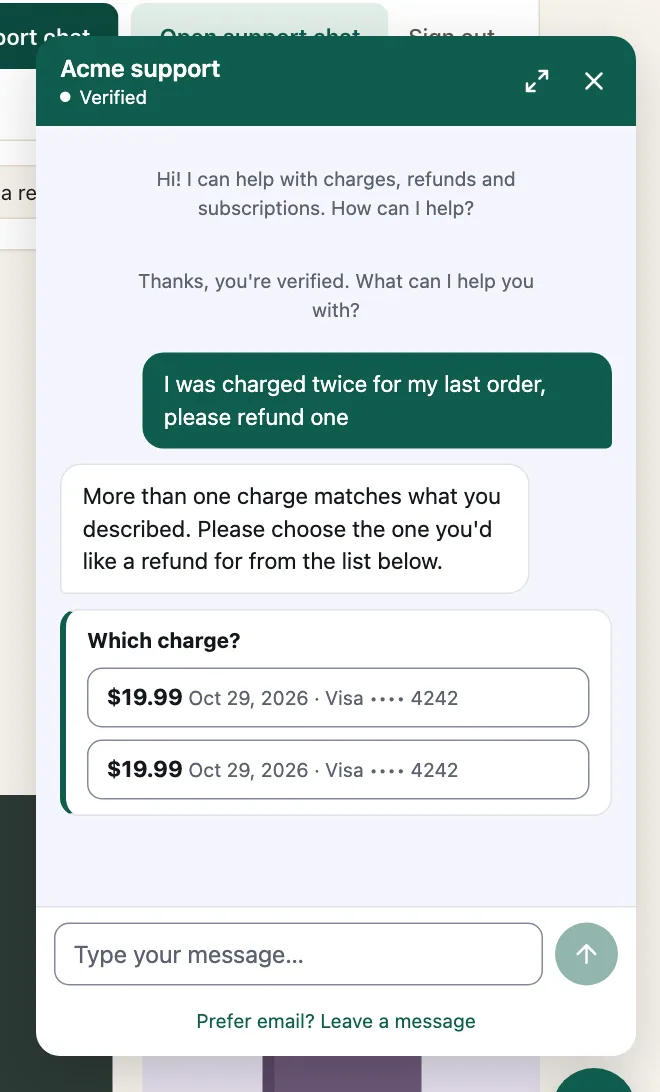
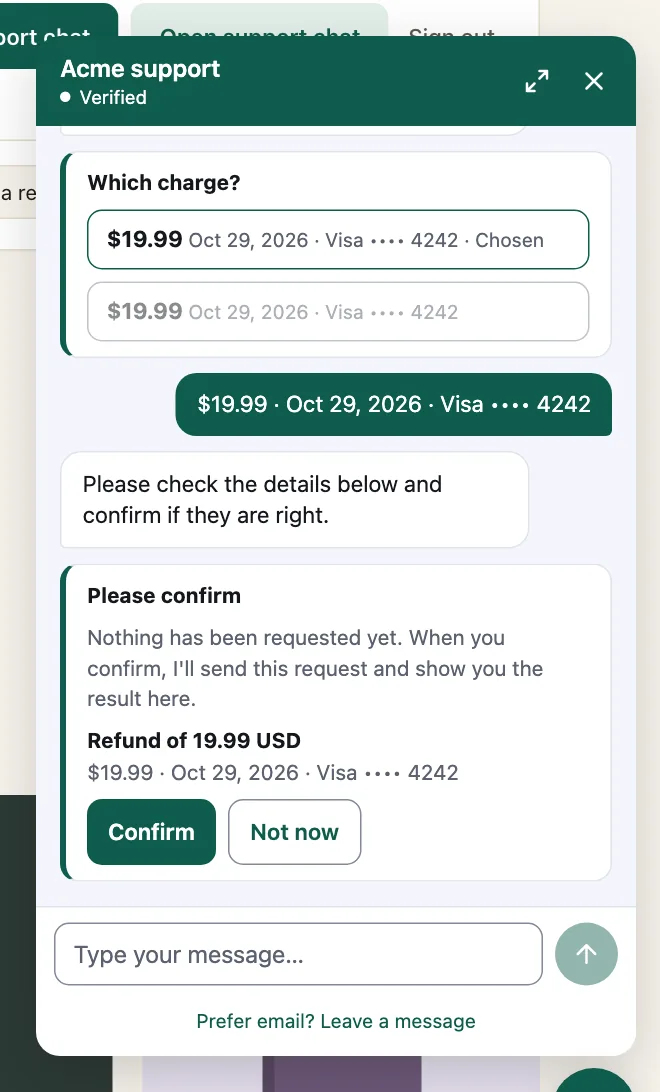
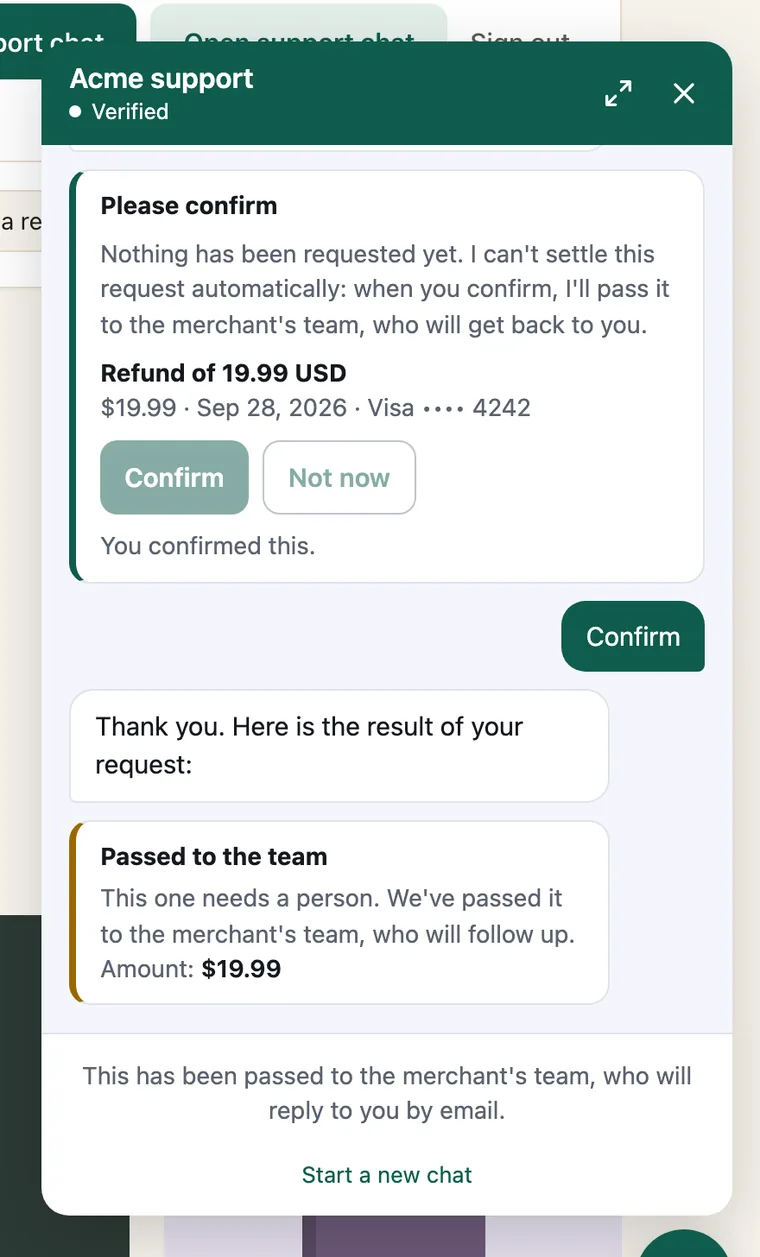
Here is a real conversation from the demo shop. The customer is signed in on the shop, so the chat starts verified.
Behind those three screens:
- The model read "I was charged twice for my last order" and proposed a refund.
- Chargeless looked up the customer's charges itself and offered only the ones that can be refunded.
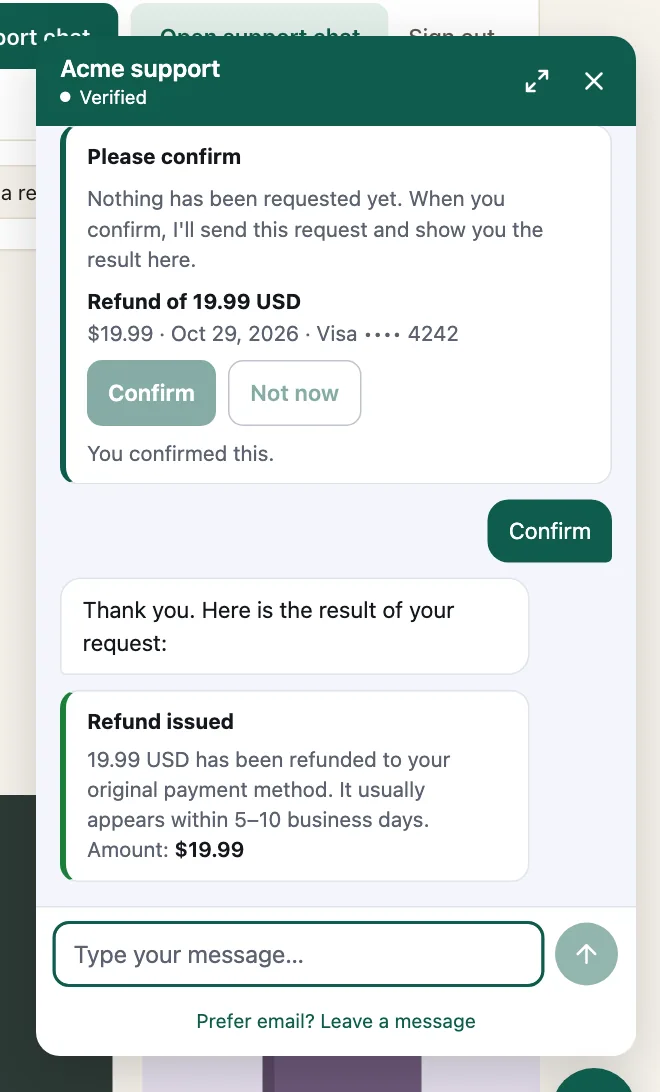
- When the customer pressed Confirm, Chargeless read the account again, ran the request through the published policy (identity, the charge, reason, window, amount, limits, rules), recorded the decision and the action, and only then asked Stripe to refund.
- The outcome card came from the action record, not from the model.
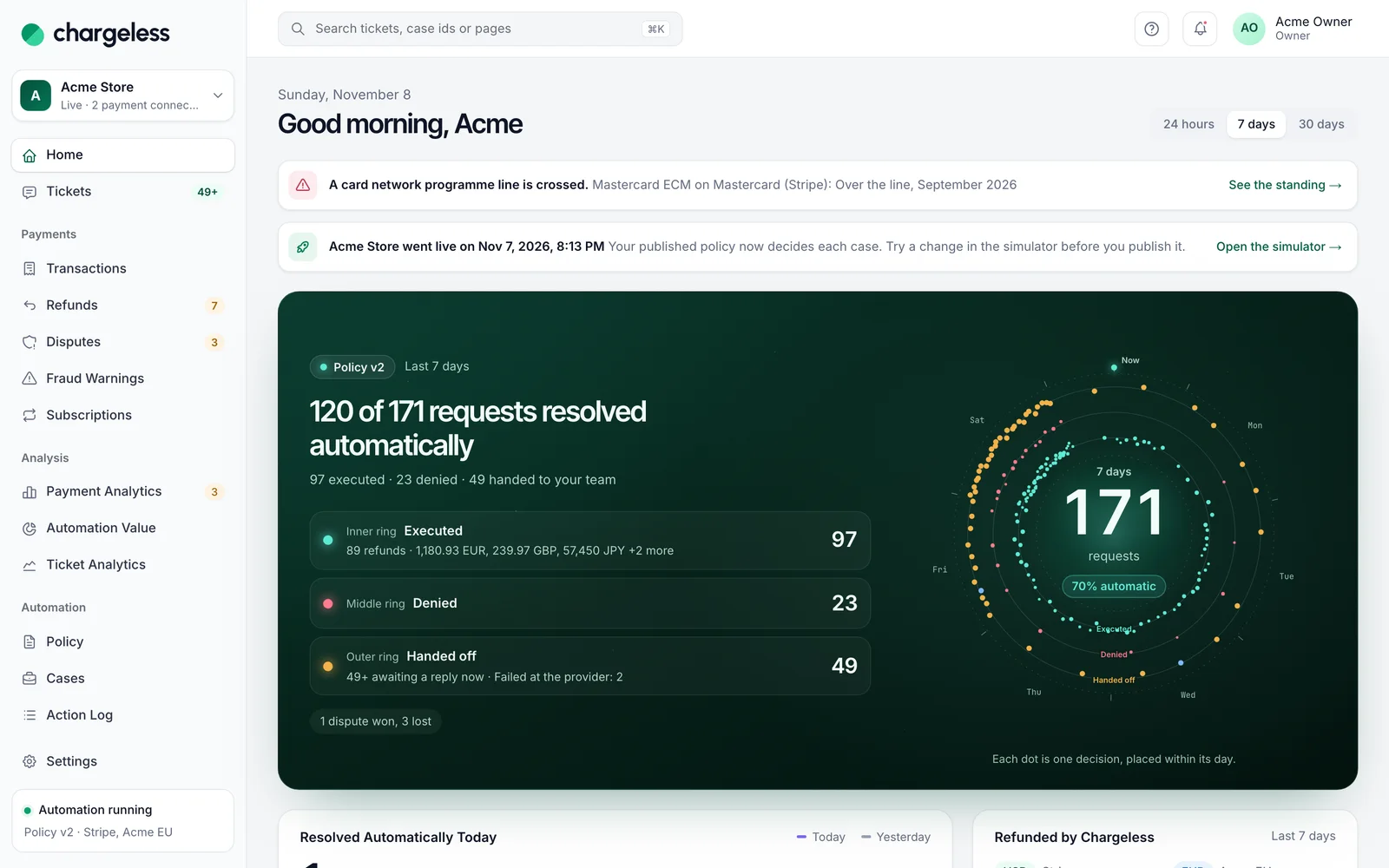
On your side, the decision appears at once in the Action Log and on Home, with every check it passed.
When the policy does not allow a request, the customer is told before they confirm that it will go to your team, and the chat ends with a handoff:
What it handles
| Request | Where it comes from | What Chargeless can do |
|---|---|---|
| Refund | Chat, email, web form, your helpdesk | Refund the charge, in full or in part, within your policy |
| Cancellation | Chat, email, web form, your helpdesk | Cancel the subscription (and, if your policy says so, offer a refund of the last charge) |
| Payment question | Chat, email, web form, your helpdesk | Answer from the customer's verified account data |
| Early fraud warning | Your payment provider | Refund the warned charge before it becomes a chargeback, and optionally cancel the subscription |
| Dispute | Your payment provider | Accept small disputes, submit evidence for the rest, or hand them to your team |
Every path ends in one of three ways: executed (the refund or cancellation was carried out), declined (with a clear reason), or handed to your team.
The trust model
Chargeless uses an AI model to understand customers and write replies. The model is never trusted with money:
- The model proposes. It reads the customer's message and suggests what they want, for example "refund this charge".
- The platform decides. Chargeless checks the proposal against your published policy, using facts it reads itself from your payment provider (the charge, its age, what was already refunded, the customer's history), never what the customer claims.
- The customer confirms. In the chat, nothing happens until the customer presses Confirm on a card that states exactly what will happen.
- Every decision is recorded. Each decision is stored with the policy version it was made under, the facts it was evaluated on and every step it passed or failed. You can read it on the case page.
Beyond that:
- The model cannot call your payment provider, your helpdesk or anything that moves money.
- Every reply is checked before it is sent. A reply that claims something the records do not support ("your refund has been issued" when it has not) is blocked.
- Outcomes shown to customers ("Refunded 24.00 EUR") come from templates fed by the action record, not from the model.
- Customer messages, helpdesk content and payment data are treated as data, never as instructions to the model.
- Customers must prove who they are before any payment detail is shown (see Widget and identity).
The pieces
- The widget: the chat on your site.
- The policy: your rules for what may happen automatically (Write and publish your policy).
- Payment connections: Stripe, or your own payment system (Integrations).
- Tickets: where your team picks up what the automation hands off (Tickets).
- The merchant panel: where you configure everything and see every decision.
Safety by design
- Limits you cannot switch off: per-customer refund limits, workspace refund limits per hour and per day, and a circuit breaker that stops automatic refunds when they run far above your usual rate.
- An emergency stop that turns every automatic money action into a handoff, at once.
- Idempotent actions: each refund or cancellation is recorded before it is sent to your provider, with a key that makes a retry safe, so a customer is never refunded twice for one request.
- No card numbers: Chargeless never sees or stores full card data.
See Security and safety.
What's available today (Phase 1)
- Payment providers: Stripe, and your own payment system through our merchant-provider contract (REST or MCP). Several connections per workspace. dLocal, Ecommpay and Adyen are not available yet.
- Helpdesks: Zendesk, and any helpdesk through the webhook connector. Freshdesk and Intercom are not available yet.
- Channels: chat widget, widget contact form, email inboxes, helpdesk tickets.
- AI model: Claude Haiku 5.5 for every role. Choosing a model per role is not available yet.
- Languages: the widget speaks English, Turkish, Spanish, Portuguese (Brazil), French, Arabic and Russian.